Null

Show Posts

This section allows you to view all posts made by this member. Note that you can only see posts made in areas you currently have access to.


Messages - Oldsquirt

Pages: 1 ... 7 8 [9] 10 11
201
Engine Mechanical / Electrical / Re: alternator mounting
« on: January 09, 2008, 08:56:02 PM »
ForkedUp, the hole on the right side of your motor plate was intended to be the alternator pivot. You will have more room for the alt on that side as the exhaust on that side sits an inch or two further back. You might even consider using one of the mini- or ultra-mini alternators to help with the fit issue. It is nice to see you have a marine-equipped version of the GM 10SI alternator, though.

202
Project Boats For Sale / Re: 1966 Tahiti flat bottom???
« on: January 07, 2008, 07:30:53 PM »
Saw that ad over the weekend. Realized at a glance it was a v-drive not a jet. Perhaps the Tahiti is the bare hull in the background? Since it's only about 15 minutes away I ---almost--- went over to look at it. The fact that the back yard looks like a junkyard puts it in a part of that area I'd just as soon not be caught, or found, dead in. :D

203
Engine Mechanical / Electrical / Re: Torque vs Horsepower
« on: January 02, 2008, 12:26:00 PM »
Sorry. NOT arguing with the article. Never was. I think it is a nice piece showing how the formula was derived. I was doing nothing but trying to clarify that NO signifigance, other than mathematics, should be given to the 5252 number. It is clear you do not understand my point. Metric system was, and I seem to have to repeat myself, brought up only to help illustrate that fact. No more, no less.

204
Engine Mechanical / Electrical / Re: Torque vs Horsepower
« on: January 02, 2008, 12:00:45 PM »
Again, I brought up the metric system only to point out that if you change the SIZE of the units, the formula comes out with a different constant. The actual real world output doesn't change, just the number and magnitude of the units chosen to report it.

So, tell me, since you seem to be bothered by my statements regarding the "5252" constant in the formula, do YOU feel that there is any REAL signifigance to the "5252" number? If so, please explain.


205
Engine Mechanical / Electrical / Re: Torque vs Horsepower
« on: January 02, 2008, 11:40:15 AM »
Don't misunderstand . I was NEVER being a critic. I was trying to point out the insignifigance of the "5252" as far as how one goes about building or setting up and engine for any specific purpose. That number has been misused and misunderstood by far too many individuals in the past. As I tried to say before, that "constant" only applies to one set of measurement "units", in this case Horsepower and Pound-Feet. If the relative size of the "units", not the number, changes, so to does the "constant". If Watt had chosen a different number for his definition of HP, then the  number "5252" would not be the "constant" in the HP/Tq formula. The example of the metric units should make that quite clear.

I'd still like to know what site the article came from to see if there is any other interesting reading.

206
Engine Mechanical / Electrical / Re: Torque vs Horsepower
« on: January 02, 2008, 11:03:01 AM »
I think he meant math is always constant, i.e.: 1 + 1 = 2 (never changes)

Perhaps we could let him explain his remark? ;)

I asked because the formula itself contains a "constant", in this case the number "5252", and it ONLY APPLIES when using the Power and Torque units of HP and LB-FT. If you were to change to the metric(aka SI) units, the "constant" changes to approximately "9545". This means that the point where the Power and Torque numbers are equal changes to that same RPM. BTW, I say approximately because it depends on how many decimal places you carry each number out to in the conversion. Using 1 HP = .746 Kilowatts and 1 lb-ft torque = 1.356 Newton-meters, the constant calculates to "9546". I have also seen it as "9543" and "9549".

So, in metric units, the formula becomes: Kilowatts = Newton-meters x RPM/9546

207
The No Wake Zone / Re: Does Anyone Know "COLE"
« on: January 01, 2008, 06:30:52 PM »
Yeah, when he told me that, I wondered why he had informed me it was mine if I wanted it, considering he had someone else interested who had responded before me. Seemed odd.

208
Engine Mechanical / Electrical / Re: Torque vs Horsepower
« on: January 01, 2008, 06:23:25 PM »
In that case, just a simple "found this at--fill in name of site---" would suffice. It's nice if an author gets credit for his/her work. It's also nice to be able to go to the source and see if there is anything else of interest to read.


Not sure I understand your "math is a constant" remark?

209
The No Wake Zone / Re: Does Anyone Know "COLE"
« on: January 01, 2008, 06:12:43 PM »
If what Rexone posted on Powerboats.com a week or two back is correct, you should have access to your PMs when the site comes back up.

By the way, the seller had originally told me the handle was mine if I wanted it. When I replied shortly after that, he told me it was sold. Gave me kind of bad feeling about the guy.

210
Engine Mechanical / Electrical / Re: Torque vs Horsepower
« on: January 01, 2008, 06:04:44 PM »
Interesting information, but you really should credit the "source" of the document.


Horsepower = torque x rpm / 5252

Here's an interesting bit of trivia; below 5252 rpm any engine's torque number will always be higher than its horsepower number, and above 5252 rpm any engine's horsepower number will always be higher than its torque number. At 5252 rpm the horsepower and torque numbers will be exactly the same.

This bit I have quoted is not exactly "trivia". In fact, the mathmatical equation, for any one who has a moderate grasp of math, states those facts directly. What is important to know and understand is that the crossing of the curves at 5252rpm is of absolutely no signifigance to the design or operation of the engine at all. It is strictly the result of the relative magnitude of the units used for Power and Torque. If one were to change to the commonly used metric equivalents, the constant, and therefore the RPM at which the numbers are equal, would change to reflect the difference in magnitude of the metric units.

211
The No Wake Zone / Re: Sorry had to do it ...
« on: December 24, 2007, 10:31:55 AM »
One of the most entertaining threads ever in Just Jets. Love that look on 'lil "Test Unit" Busby's face. Gotta be thinking, "what the f*** is Dad trying to do to me?" :D If I recall, the M-O-M unit wasn't all that pleased with the "safety gear". I still think the experiment would have gone off better with a lighter weight pilot. A neighbors dog or cat, taped to the skateboard,  would have surely been more fun to watch.......... ;D

212
Jet Pumps / Re: Jet Boats...How Do They Work?
« on: December 23, 2007, 09:06:44 AM »
At some point, the impeller's horsepower curve will cross the engine's hp curve on the downside of it. The RPM at which the two curves meet on the downside will be the max RPM the engine will be able to spin that particular impeller. At this RPM, the impeller's HP demand is still going up, while the engine's hp curve is going down. Because the engine can no longer make anymore hp, the engine is incapable of spinning the impeller any faster than this RPM.

As on the other board where you posted this, I will have to point out that the highlighted statement above is incorrect. BY DESIGN, impeller absorption curves intersect engine HP curves on the UPSLOPE. In other words, they intersect at an RPM below that at which peak HP is produced. The only reasons to find an Engine/Impeller combo that has its intersect on the downside would be a big mistake in impeller choice, or someone was "experimenting". There is NOTHING TO BE GAINED in exceeding the RPM at which Peak HP is produced.


213
Jet Pumps / Re: Name that Droop
« on: December 11, 2007, 06:33:43 PM »
I am thinking Aggressor but I want your guess..

That would be my thought as well. Can you measure the pin angle?

214
Engine Mechanical / Electrical / Re: witch gen?
« on: November 21, 2007, 10:15:15 AM »
If it's a 78 block & heads, it's a Gen IV, which I find to be the most commonly available block.

Gen IV was from 70-90 I believe.


No such thing as "Gen IV". The correct designation is "Mark IV". GM NEVER used the designation "Gen IV"

215
Engine Mechanical / Electrical / Re: N.O.S. PLUMBING
« on: November 12, 2007, 06:53:31 PM »
Before you start drilling, check with your machinist to see what it would cost to set the manifold up in his mill to drill & tap the holes. Might not be that expensive and it will ensure that they are all done in line and at the same angle(makes it look a lot nicer :) )

216
Engine Mechanical / Electrical / Re: Engine Block work
« on: November 12, 2007, 06:20:34 PM »
Definitely wait until the machine shop has fully inspected the block. Make sure they fully mag the block and check the integrity of head bolt threads(especially the 4 that have the locating dowels) as well.

217
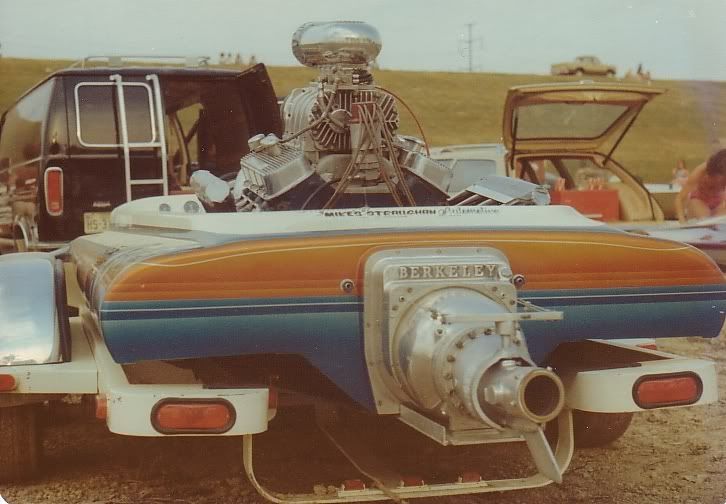
Boat Showcase / Re: Old pictures...fast jets
« on: October 19, 2007, 11:32:17 AM »
This looks like a Rogers Dragstar ..... ??? maybe.


-beerjet-

If you take a close look at this pic, just ahead of the trailer fender and below the tail light of that Econoline, you can see that this hull has sponsons, making it a jet hydro. The paint job seems reminiscent of Sanger with the narrow color bands with fades, but the Sanger jet hydros that I have seen were more of a "tunnel" hydro. This one seems to have just a very small(1/4"?) dropped chine. Of course those might just be the result of reliefs in the hull for recessed cav plates? Would be nice to see more pics........Hondo also made a jet hydro, but it had a much more pronounced gunwale, especially in the rear, where it kind of flared upward. It also was more of a tunnel-hydro design, I think.

218
Engine Mechanical / Electrical / Re: Oil Pan?
« on: October 16, 2007, 06:49:19 PM »
Theres 2 Keith Eckert pans on hotboat. He is asking $200 OBO and real desperate to sell em. Those are normally around $600 or so.
http://www.hotboat.com/forums/showthread.php?t=161156&highlight=oil+pans

Before laying out any money for one of these, make sure it is only 8" deep. Most offshore pans are deeper and will not fit in a typical jet application. If they are the 9" deep pans, they will hit the intake.

219
Projects / Re: 16 Tahiti project
« on: October 04, 2007, 01:46:46 PM »
Tom, if you haven't already torn the pump down, could you measure the clearance at the front of the impeller? Curious to know how loose those were from the factory. Pic seems to indicate a pretty wide gap.

. .... Didn't look like it did much damage to the impeller.  Am I right?

Although a person could spend the time(and money) to reshape each the leading edges of those impeller vanes, I'd say there is enough damage there to consider that one toast. Don't forget the likely wear/damage to the wear ring surface. New aluminum impellers are relatively inexpensive.


220
Engine Mechanical / Electrical / Re: 455 OLDS Heads
« on: October 03, 2007, 03:12:03 PM »
Big valve = 2.072" intake
Small valve  = 2.000" intake

221
Projects / Re: 16 Tahiti project
« on: October 03, 2007, 11:48:21 AM »
We had a lot of fun in my buddy's Tahiti 16 back in the early 80's. :)


222
Engine Mechanical / Electrical / Re: 425 crank in a 455
« on: September 20, 2007, 11:41:25 AM »
... what's the difference between cast and nodular?

First off, both are cast iron. The nodular cast iron is more ductile/less brittle than the the "standard" cast iron. This is the result of controlling the way that some of the carbon turns to graphite in the alloy. In "nodular" the graphite comes out as small spheres or nodules, hence the term "nodular" cast iron. In the standard iron it tends to appear as "flakes", which interrupts the grain structure.

223
Engine Mechanical / Electrical / Re: 425 crank in a 455
« on: September 20, 2007, 11:33:53 AM »
The 425 and 455 Oldsmobile blocks are identical all the way down to the factory boresize. The crankshafts are interchangable.

The blocks are not "identical". Can't recall if all, or only early 425s had a different lifter bore angle. Not a major difference but one that should be considered if expecting the most out of a cam choice.

The crankshafts are NOT INTERCHANGEABLE. There is a .275" difference in stroke so they obviously wont "interchange". Perhaps you should have said that either crank will fit either block(although the 425 may require clearancing at bottom of cylinders for a 455 crank/rod combo), but displacement will be determined by the crank chosen, and that the appropriate piston/rod combination will have to be used. The rear flange of early(1965?) 425s has a different bolt pattern. The 455 PTO will not fit this different pattern. I think Glenwood still lists the 425 item.

The 425 Olds all came with a beautiful forged crankshaft. If you have not yet seen one of these cranks, you will love looking at it. I think you should use the 425 crank, absolutely. By the way, they have huge rod journals and you can offset stroke these Olds 425 crankshafts and have a nice forged stroker crank. Aftermarket piston/rod combos will need to be figured out by you, then stroke the crank accordingly. By the way, I'd recommend using fully-grooved bearings in your Olds boat motor so as to establish continuous oil feed to the rod bearings.

Great idea if one is building a motor from scratch, but it is a pricey proposition as it will require a non-stock combination of rods and pistons. For someone just trying to put a 455 back together as a 455, the 425 crank isn't going to work without being offset ground to the 455 stroke. This will still require the use of non-stock pistons/rods. If just using the 425 crank as is, it would still require the use of 425 rods/pistons.

Its too bad that the Olds strokers were never as common as the Ford or Chevys. I always wanted to build a bigger Olds based on an offset ground 425 forged crank or even an offset ground nodular iron crank(had one in my 455).

224
Jet Pumps / Re: Machining Berk bowls
« on: September 15, 2007, 01:26:27 PM »
Slightly better, yes. Probably nothing the recreational user would notice, performance wise. There are even 2 different versions of the JC bowl and one is preferrred by those who have converted the bowl for racing use. Only a little difference, but important to those for whom a few tenths of a second  might count.

225
Jet Pumps / Re: Machining Berk bowls
« on: September 15, 2007, 01:12:21 PM »
The last pro I know who was doing that conversion was Jack at MPD in Costa Mesa. he used to do them in the off season but I read a while back he had discontinued that service. Considering the cost(approx $350), a used split bowl is probably a less expensive alternative.

Pages: 1 ... 7 8 [9] 10 11

Null

SMFPacks CMS 1.0.3 © 2026